Bin picking oily metal parts: what changes when there is an oil film
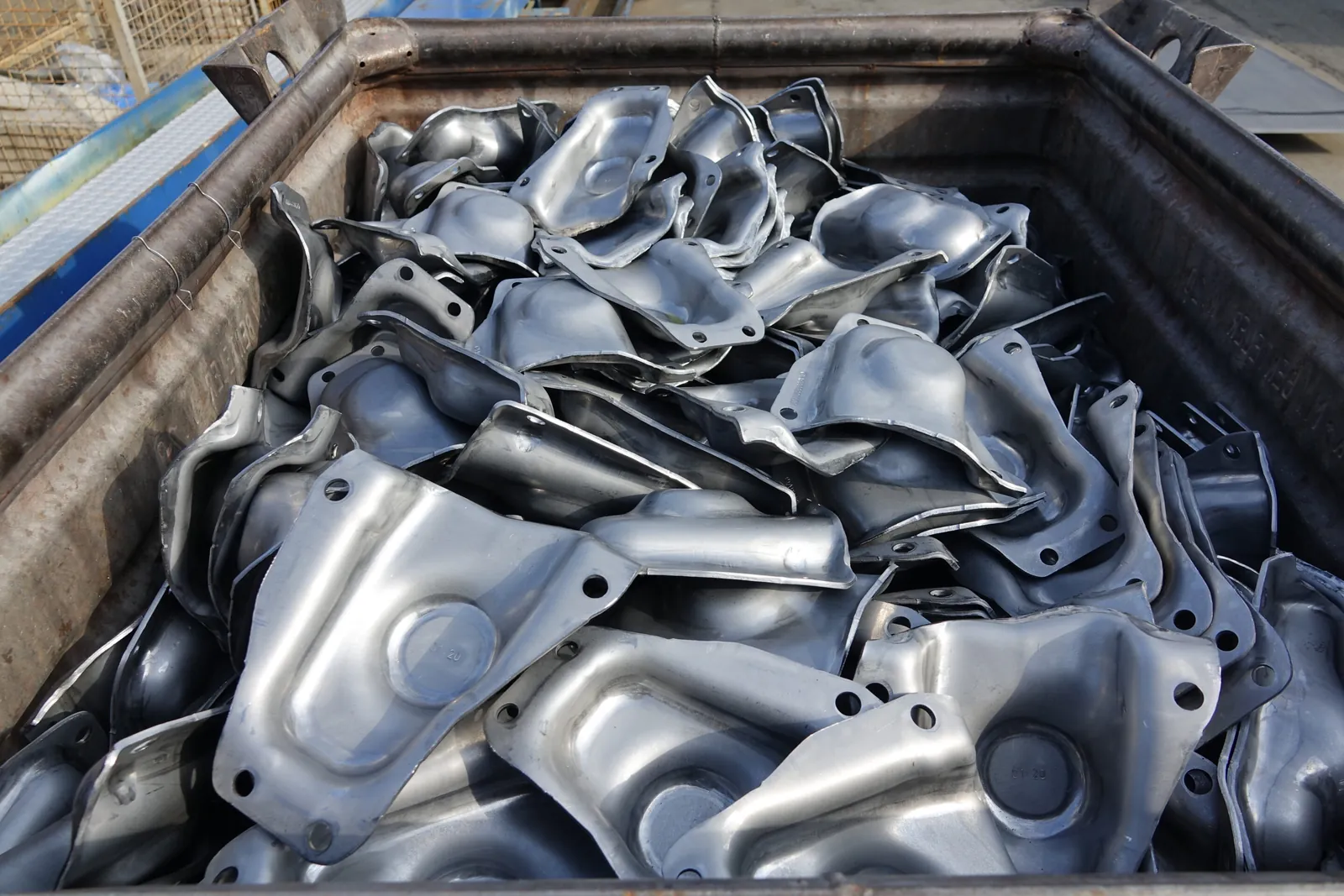
Oiled steel parts, or parts still wet with coolant, change a bin-picking cell more than you would expect – in the 3D data, in detection, at the gripper and in maintenance.
This article is part of our guide 3D vision for glossy, oily and metallic parts. The general physics of reflective surfaces is explained in Why shiny parts fool 3D cameras.
Why oil matters optically
A machined or blasted steel surface is rough on a microscopic scale. That roughness scatters light and gives the part a matte, grey look. An oil film fills in the roughness and creates a smooth top layer. Optically, the part turns from mostly diffuse to mostly specular: highlights become sharper and brighter, and the rest of the surface gets darker.
Three properties make oil harder than a uniformly glossy finish:
- It varies. The amount of oil differs between batches, between suppliers, between the top and the bottom of a bin, and over a shift as the oil drains.
- It is uneven. Drops collect at edges, in holes and on the lowest points of a part. A single part can show matte, glossy and wet areas side by side.
- It travels. Oil ends up on the bin floor and walls, on the gripper and – as mist – on the camera window.
The bin is part of the problem
In bin picking, the camera never sees parts in isolation. Three situations deserve attention in every test:
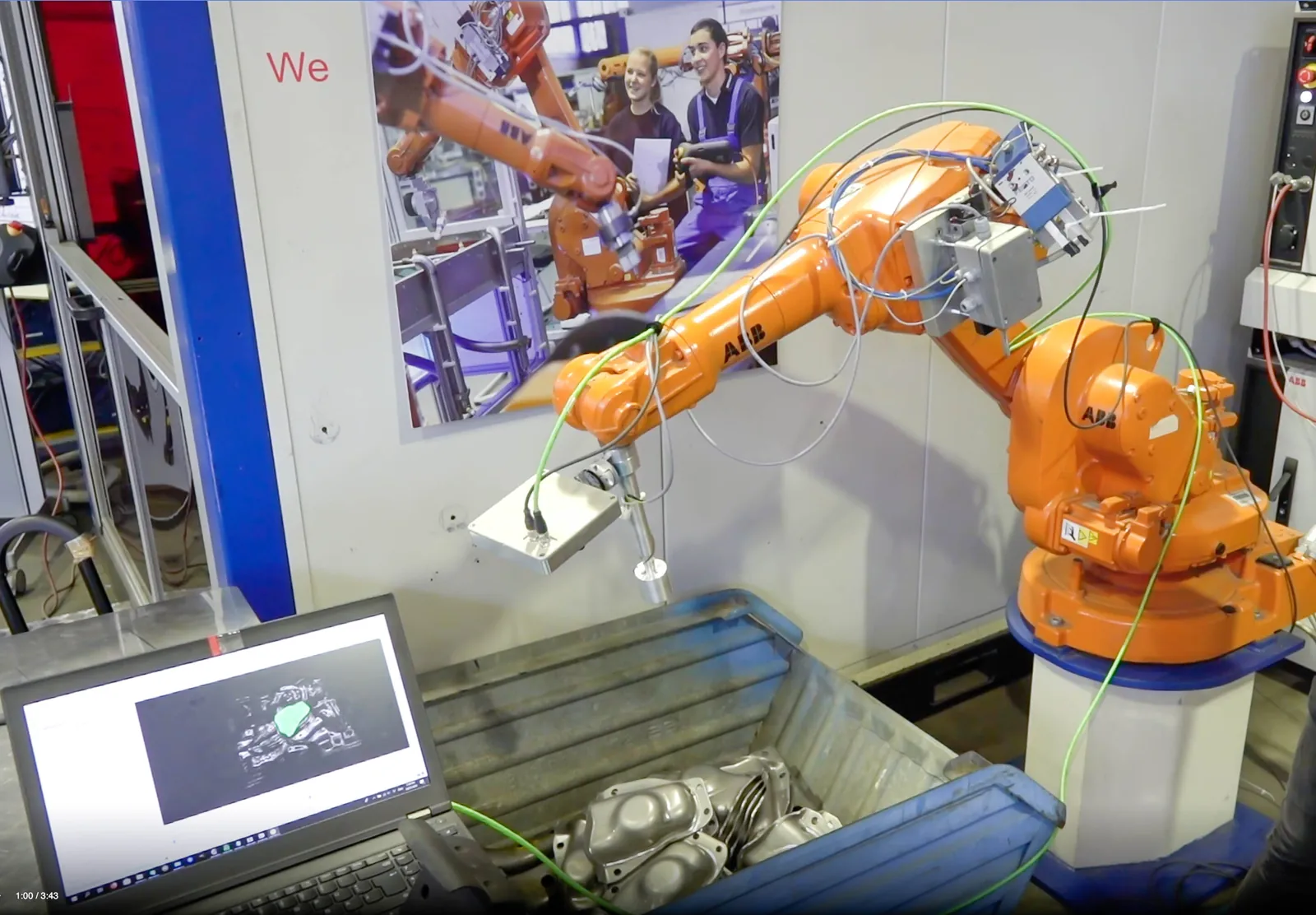
The bin floor. A shiny, uneven floor – a metal load carrier, an oily plastic bin, a ribbed base – makes it hard to separate the last parts from the background. In the BENTELER trials, the uneven floor of the load carriers was one of the explicit challenges.
The walls and corners. Reflections from the bin walls are strongest when only a few parts remain near the edges. That is also where the gripper has the least room.
The fill level. A full bin shows mostly the tops of parts; a nearly empty bin shows their sides, the floor and the walls. Detection that works on a full bin can fail on the last five parts.
Getting usable 3D data
The light-field camera LumiScan X captures each scene from 13 viewpoints at once. Highlights that appear at different places in different views can be recognised as inconsistent instead of being turned into ghost points, and the depth of the remaining surface is estimated from many observations. On oily parts, this redundancy is exactly what you need.
In the cell, three measures add to it:
- Shield the scene from changing light. Daylight and hall lights create highlights that move during the day.
- Keep the camera window clean. Plan a cleaning interval or a protective window that is easy to wipe; oil mist settles faster than you think.
- Look again when in doubt. A camera on the robot can take a second shot from another angle when a part is ambiguous.
Detection: CAD or AI?
LumiScan VGR can locate parts by matching a CAD model to the point cloud, or with AI-based detection. On oily parts, AI detection is often the more robust option, because it learns how your parts look under your conditions – including highlights and wet patches. Mixed boxes are a second reason: when a bin contains several part types, the detection also has to classify.
What matters is the training data. Annotate images from:
- full, half-full and nearly empty bins,
- fresh and drained oil conditions,
- every part type and supplier that may arrive at the cell.
With LumiScan Annotation Framework and Training Framework, you annotate and train in-house and can retrain when a new supplier or a new oil changes the look of the parts. LumiScan VGR Lite offers the same collision checking and path planning with purely AI-based detection, without a CAD model.
Grasping and verifying
Oil also changes the gripper’s job. Vacuum cups can lose their seal on oily or wet surfaces; magnetic and mechanical grippers are common for oily steel. The gripper is designed by the integrator, but the vision system has to know its geometry: LumiScan VGR checks every path into and out of the bin against the 3D model of the gripper and the current point cloud.
Two practices make the process stable:
- Rescan after every pick. Parts slide when a neighbour is removed. A fresh image before each pick costs little time compared with a failed grasp.
- Verify the pick. Gripper sensors or a quick check of the gripper contents catch parts that slipped on the oil.
Maintenance
Oil is a slow process variable. Plan for it:
- a cleaning interval for the camera window and lighting,
- a periodic check of the calibration between camera and robot (the LumiScan Calibration app guides hand-eye calibration),
- a routine for retraining when the part condition changes.
Checklist for a test with oily parts
- Send parts as they really arrive, including the oiliest batch – and say how they were stored.
- Include the real load carrier, ideally a used one.
- Test full, half-full and nearly empty bins, including parts at the walls and in the corners.
- Agree on the target: pick rate, pose accuracy derived from the gripper tolerance, cycle time.
- Name the gripper principle you plan to use.
More on how to prepare a test: Testing glossy parts before you invest. The ready-made combination of camera and apps for this task is our Bin Picking Solution Set.
Frequently asked questions
Why does an oil film matter if the geometry stays the same?
Because the camera sees light, not geometry. Oil fills in the micro-roughness of a machined surface, so the part turns from mostly matte to mostly mirror-like: highlights get sharper, the rest of the surface darker. And the amount of oil varies from batch to batch and over a shift.
Do I need a CAD model for bin picking oily parts?
No. LumiScan VGR can locate parts with a CAD model, but on oily parts AI-based detection trained on images of your real parts is often more robust. LumiScan VGR Lite works purely AI-based, without a CAD model.
How often does the AI detection have to be retrained?
There is no fixed interval. Retrain when the look of the parts changes noticeably – a new supplier, a different oil, a new variant. With LumiScan Annotation Framework and Training Framework, you annotate and train in-house.
Which gripper works for oily steel parts?
The integrator designs the gripper. Vacuum cups can lose their seal on oily or wet surfaces, so magnetic and mechanical grippers are common. Whatever you choose, the vision software needs its geometry to check every path into and out of the bin for collisions.
How do I keep the camera clean in an oily environment?
Plan a protective window that is easy to reach and wipe, a fixed cleaning interval, and a mounting position outside the direct path of oil mist. Checking the image quality regularly shows when cleaning is due.

PD Dr. Christoph Garbe
Christoph Garbe co-founded HD Vision Systems in 2017 and leads the company. As a Privatdozent (associate professor) at Heidelberg University (IWR), he heads a research group for image processing.