Metric depth from one shot: plenoptic camera meets foundation model
Part 2 of our series Light-field research, read for practice. Part 1 was about tracking shiny objects without a CAD model.
Monocular depth networks have become astonishingly good. Models such as Depth Anything produce detailed, plausible depth maps from a single photo. They have one fundamental weakness, though: they cannot know the scale. Whether the scene is a toy model or a real car is unobservable from a single image – the network guesses. For a robot that has to grip a part, a guess is not enough.
The paper by Blanca Lasheras-Hernandez, Klaus H. Strobl, Sergio Izquierdo, Tim Bodenmüller, Rudolph Triebel and Javier Civera (German Aerospace Center DLR, TU Munich, University of Zaragoza), presented at ICRA 2025, asks a question that sounds obvious to us: what if the scale comes from the camera itself? A focused plenoptic camera sees the scene through thousands of microlenses with tiny but well-defined baselines – enough to triangulate metric depth in a single exposure.
How it works
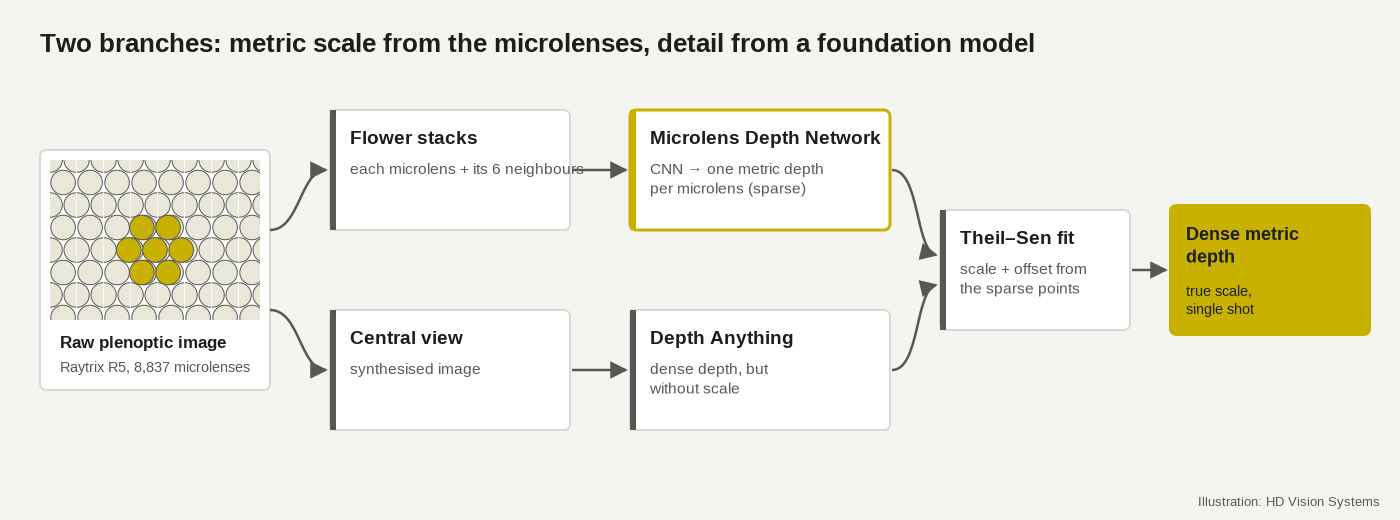
The authors use a Raytrix R5, a focused (“plenoptic 2.0”) camera with 8,837 microlenses on a 4.2-megapixel sensor. The pipeline has two branches:
- Metric, but sparse. For every microlens, the images of the microlens itself and of its six hexagonal neighbours are stacked into a “flower stack”. A compact convolutional network, the Microlens Depth Network, predicts one metric depth value per stack. Weakly textured regions are filtered out, because there the disparity is unreliable.
- Dense, but without scale. From the plenoptic image, a conventional-looking central view is synthesised. Depth Anything turns it into a dense, detailed depth map – correct in shape, but without scale.
The two are joined with a robust Theil–Sen fit: the dense map is sampled where sparse metric values exist, and a scale and an offset are estimated and applied to the entire map. The result is a dense depth map at true scale from one shot.
Because there was no suitable public dataset for plenoptic 2.0 cameras, the team built one: the Light Field & Stereo (LFS) dataset with 59 laboratory scenes, recorded simultaneously with the plenoptic camera and a calibrated stereo pair that provides the reference depth. It is available on Zenodo.
What the results show
The sparse network alone already beats the manufacturer’s software on the test scenes: an RMSE of 5.55 cm against 10.94 cm. The dense, scale-aligned result has an RMSE of 8.50 cm, while Depth Anything on its own – which simply does not know the scale – is far off on the threshold metrics. Interestingly, the dense output does not beat the sparse one on every metric; filling in the gaps costs some accuracy where the sparse network is confident.
The limitations are stated clearly: a single global scale-and-offset fit cannot correct errors that differ between regions of the image, occlusions are not yet handled explicitly, the dataset is small and recorded under laboratory conditions, and decoding the raw plenoptic data still relies on the manufacturer’s tools.
Our take
We like this paper less for its numbers than for its architecture. It shows a pattern we expect to see much more often: physics provides the scale and the trust, the foundation model provides the detail. The light field contributes what a neural network cannot hallucinate – metric geometry from known optics – and the network contributes what sparse disparity cannot deliver – complete, sharp surfaces.
For industrial use, two points matter. First, the errors reported here are in centimetres at room scale; robot cells work at short distances and need millimetres, which is the regime industrial light-field cameras are designed for. Second, a single global fit is the obvious next thing to replace: local or per-object alignment, weighted by the confidence of the light-field disparity, would keep the strengths of both branches. That is exactly where a calibrated light-field camera has an advantage over any monocular setup – it knows where its own depth can be trusted.
Next Tuesday: how to capture light fields much faster than consumer light-field cameras allow – by packing several frames into one sensor readout.
The paper
Blanca Lasheras-Hernandez, Klaus H. Strobl, Sergio Izquierdo, Tim Bodenmüller, Rudolph Triebel, Javier Civera: Single-Shot Metric Depth from Focused Plenoptic Cameras. IEEE International Conference on Robotics and Automation (ICRA) 2025. Preprint: arxiv.org/abs/2412.02386. Dataset: zenodo.org/records/14224205
More on the basics: Plenoptic cameras in industry.

PD Dr. Christoph Garbe
Christoph Garbe co-founded HD Vision Systems in 2017 and leads the company. As a Privatdozent (associate professor) at Heidelberg University (IWR), he heads a research group for image processing.